
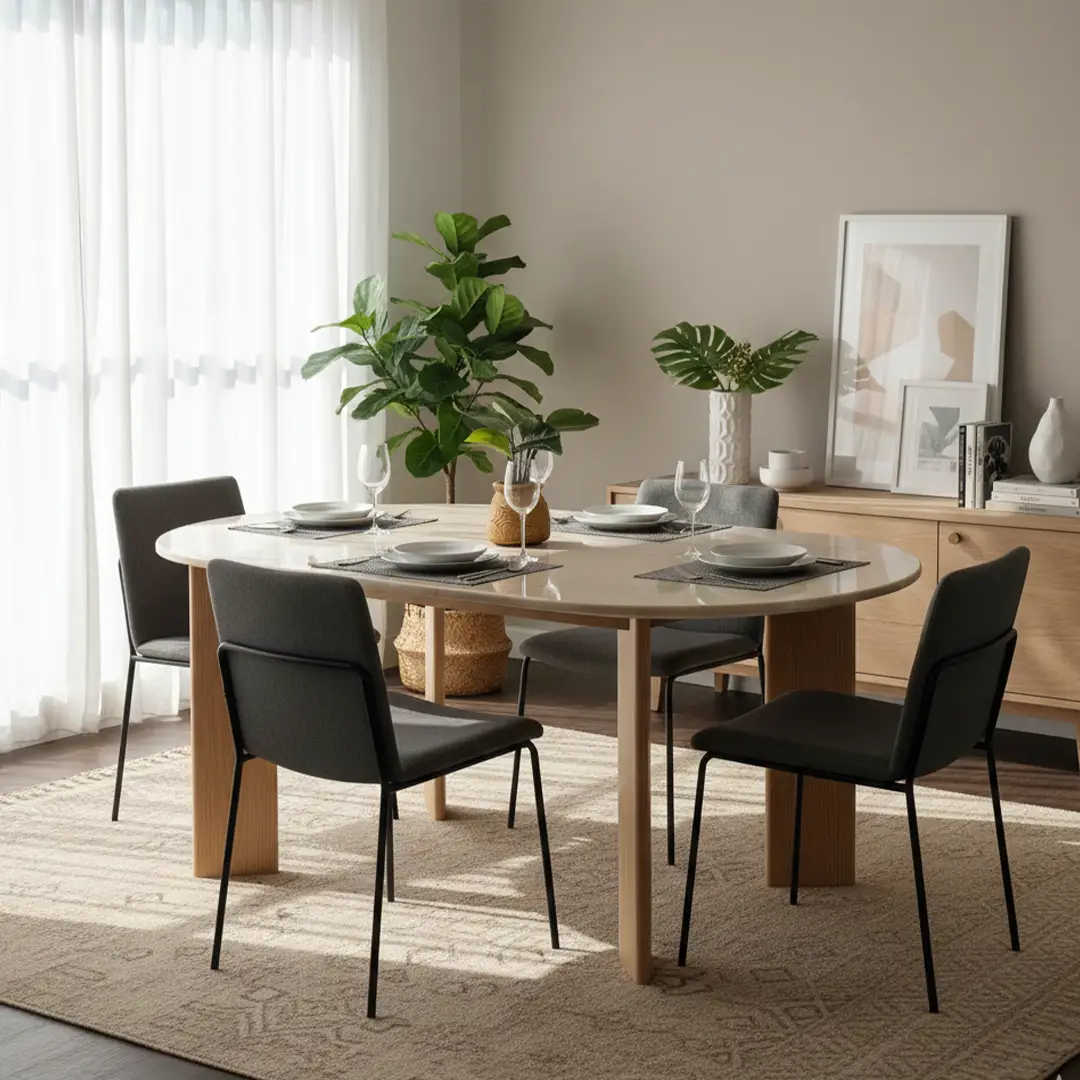
Contrast is what separates a room that looks assembled from one that looks designed. When every element exists in easy harmony, a space can feel pleasant but forgettable. Introduce deliberate tension, a rough texture beside a smooth one, something dark against something pale, and the room suddenly has a pulse. Marble, with its inherent weight and visual complexity, is one of the most powerful tools for creating that kind of tension.
The stone itself already holds contrast within it. Look closely at any luxury marble furniture piece and you will find a surface that is simultaneously cool and warm, uniform in material yet wildly individual in marking. What surrounds the marble either amplifies that quality or flattens it entirely. The homes that do this well are the result of deliberate choices made across material, colour, and light.
Best Ways to Create Contrast with Marble Furniture
The best marble furniture contrast ideas work well when they are layered, and when the contrasts in a room do not all speak at the same volume but instead build on one another in a way that feels coherent. The goal is not to create friction for its own sake but to generate a visual conversation between surfaces, tones, and textures that keeps the eye moving and the room feeling alive.
Here are the most effective ways to approach it:
Material Contrast
Marble’s most interesting quality in a room is how it responds to everything placed beside it. Against raw wood, its refinement sharpens. Next to linen or bouclé upholstery, its cool hardness becomes unexpectedly inviting. Styling marble furniture with tactile, organic materials is one of the most instinctively satisfying strategies because it honours what each surface does naturally.
Color Contrast
Tone is perhaps the most immediate lever available when working with marble. Premium marble furniture in white or cream reads entirely differently against a deep, saturated wall than it does against pale plaster. Dark marble placed on a light floor creates a grounding effect that gives a room genuine visual weight. The key is to work with the undertones already present in the stone.
Lighting Contrast
Light changes marble more dramatically than almost any other material. A polished marble surface in direct natural light has a completely different presence than the same piece under warm, directional artificial light in the evening. Using the contrast of marble furniturethrough lighting means thinking about where shadows fall, how the veining is revealed at different angles, and what the stone looks like at various hours of the day.
Marble Furniture Styling Tips
Beyond the broader principles of contrast, the details of how premium marble furniture is styled within a room carry enormous influence over the final result.
A few tips worth keeping in mind:
Furniture legs matter more than they seem
A marble tabletop on slim brass or blackened steel legs reads entirely differently than the same top on a solid stone or wood base. Choose legs that provide contrast in their own right, something that does not try to match the marble but instead gives it room to stand out.
Layering is what gives a room its depth
A marble coffee table surrounded by a textured rug, soft cushions, and objects in varied materials creates a composition. The same table on bare floor with nothing around it can feel sparse rather than minimal. Styling marble furniture well means thinking about what lives beside it, beneath it, and above it.
Let one marble piece be the statement
In rooms where luxury marble furniture is given space to lead, the effect is far more powerful than in rooms where multiple marble pieces compete. One commanding piece, a dining table, a console, a side table, anchors the space. Everything else supports it.
Conclusion
Contrast in interior design is less about opposition and more about conversation. The most compelling rooms are those where materials, tones, and textures seem to be in dialogue with one another, where nothing exists in isolation and every element is made more interesting by what surrounds it. Marble, precisely because of its depth and individuality, is one of the best materials for starting that conversation.
At Lamac, every piece of luxury marble furniture is designed with this in mind. The stone we select, the finishes we apply, and the forms we craft are all considered in the context of how the furniture will eventually live in a real space. Whether you are building a room around a single statement piece or layering marble into a more complex interior, we bring the material sensibility and design precision to ensure that the contrast you create feels entirely intentional.
FAQs
1.Why is contrast important when styling marble furniture?
Contrast adds depth and visual interest, preventing a space from feeling flat while highlighting the natural character and veining of marble.
2.What materials pair best with marble for contrast?
Natural materials like wood, linen, metal, and textured fabrics work well, creating a balance between marble’s smooth surface and more tactile finishes.
3.How can I use color contrast effectively with marble furniture?
Work with the marble’s undertones. Light marble stands out against darker backgrounds, while dark marble gains impact when placed in lighter settings.
4.Does lighting really affect how marble looks in a room?
Yes, lighting can dramatically change how marble appears, enhancing its veining, depth, and overall presence throughout the day.
5.Can I use multiple marble pieces in one room?
You can, but it’s often more effective to let one marble piece act as the focal point while other elements support it to avoid visual competition.
Leave a Comment
Your email address will not be published. Required fields are marked *
You must be logged in to post a comment.