
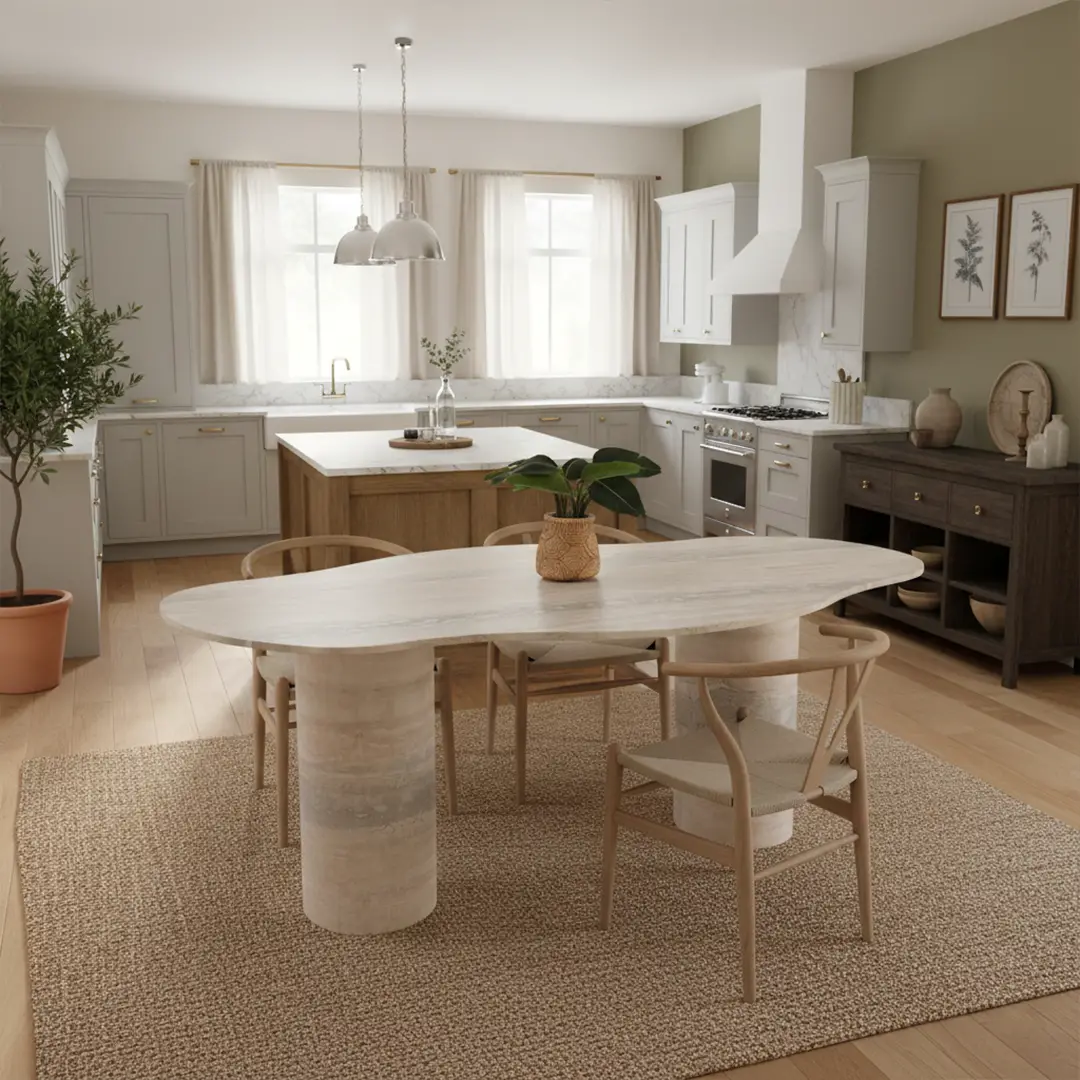
Think of your white room as a blank stage and your furniture as the permanent cast of characters. Because white walls have no color of their own, they act like a mirror for the natural light streaming in, meaning your room is never the same twice. In the early morning, your sofa might look cool and crisp under soft blue light; by late afternoon, that same piece shifts to a warm, golden-amber glow.
To make this performance truly captivating, curate your pieces for their form and physical presence. Focus on how different shapes and densities catch the shifting light throughout the day, creating subtle interplay between shadow and brightness. Your furniture becomes the architecture of the room, turning the space into a display where the sunlight acts as a built-in dimmer switch, constantly shifting the mood and personality of your home without you having to move a single chair.
This guide provides a blueprint for mastering white interiors, focusing on the interplay between natural light and architectural form. You will learn how to select furniture based on silhouette and scale to anchor a room, along with strategies for layering textures to ensure your space remains sophisticated, engaging, and warm throughout the day.
Why Furniture Selection Matters More in White Interiors
In darker interiors, colour naturally creates separation between furniture and architecture. White interiors, however, place every detail under greater visual scrutiny. Material quality, silhouette, and craftsmanship become significantly more noticeable.
Avoiding Flat and Monotone Spaces
An all-white room can quickly lose visual interest if every furniture piece shares the same finish and texture. Layering different materials creates depth while maintaining the overall monochromatic palette.
Consider pairing polished marble with soft upholstery, brushed metal accents, and warm timber veneers. These subtle variations allow the room to feel sophisticated rather than one-dimensional.
Using Texture Instead of Excess Decoration
Luxury interiors rarely depend on excessive ornamentation. Instead, they rely on tactile surfaces that naturally enrich the space.
Bouclé upholstery, veined marble, ribbed wood finishes, textured fabrics, and sculptural furniture profiles all introduce visual interest without disrupting the calm aesthetic.
Creating Contrast Without Adding Too Many Colors
Contrast in white interiors does not necessarily come from bright colours. It comes from balancing light and dark materials, matte and polished finishes, curved and linear forms, and smooth and textured surfaces.
A charcoal mirror frame, warm walnut veneer, bronze accents, or dramatic marble veining can provide enough definition to anchor the room while preserving its clean appearance.
Marble Furniture for Depth and Luxury
Nothing signals quiet luxury in a white interior quite like natural marble. Its veining does the work that paint and wallpaper can’t – every slab is unique, and the movement within the stone brings organic depth to an otherwise clean-lined room.
Coffee Tables as Statement Pieces
A marble coffee table anchors the living room both physically and visually. The Namira Coffee Table is a strong example of this principle in practice: a solid white marble top with visible natural veining rests on two fluted, cylindrical pillar legs, giving the piece rhythm and sculptural presence without competing with the room around it. At 200L × 80W × 45H cm, it’s substantial enough to hold its own in a spacious white living room while keeping the material, not the shape, as the focal point.
Dining Tables That Add Visual Weight
Dining spaces in white interiors benefit enormously from a table with real material weight. The Alice Dining Table is built from solid marble with a bold, sculptural base and is available in richly veined finishes like green marble, burgundy marble, and black zebra, each offering a different level of contrast against white walls and flooring. Available across 4, 6, and 10-seater configurations, it works as comfortably in an intimate breakfast nook as it does in a full dining room designed for entertaining.
Console Tables for Layering White Interiors
Consoles are where marble furniture can afford to be more architectural. The Arcus Bianco Console Table is crafted entirely from Bianco Lasa marble, with an asymmetric base pairing a solid monolithic pillar against a carved archway, topped with a soft, racetrack-shaped surface. At just 30cm deep, it’s proportioned for hallways, entryways, and the space behind a sofa, precisely where a white interior needs a quiet but confident visual anchor.
Upholstered Beds That Add Warmth to White Bedrooms
If marble brings coolness and structure, upholstered and veneer-finished beds bring the warmth a white bedroom needs to feel restful rather than sterile.
Soft Materials That Balance White Spaces
Soft, tactile materials like velvet, boucle, and rich wood veneers counteract the crispness of white walls and linens. The goal is a bedroom that photographs beautifully but also feels inviting enough to sink into at the end of the day.
Choosing Neutral Upholstery
Neutral doesn’t mean plain. The Alto Slope Bed demonstrates this well: its sculpted, curved headboard is offered in Black, Red Oak, White Oak, and Walnut veneer finishes, each bringing a different depth of warmth. The wide-profile frame gives the bed real presence in the room, while the veneer grain adds visual softness that upholstery alone sometimes lacks.
Creating a Layered Bedroom Look
The Luna Arched Platform Bed takes a more sculptural, minimalist approach – a five-panel arched headboard in premium veneer finishes (Black Veneer, White Oak, Red Oak, Walnut), with the option of integrated curved side tables for a fully coordinated look. For a bolder architectural statement, the Crescent Arched Bed brings an oversized arch headboard with the same range of veneer finishes, ideal for a white bedroom that wants one strong, curved silhouette to build the rest of the layering around.
Mirrors That Expand and Brighten White Interiors
White rooms already reflect light well, but mirrors amplify that effect further while doubling as some of the most sculptural furniture pieces available.
Full-Length Mirrors for Visual Expansion
Full-length mirrors do more than serve a functional purpose in a white interior; they visually extend the room. The Vertex Mirror offers a bold rectangular silhouette in a wide wood veneer frame, available in oak, walnut, black ash wood, and dyed ayous gray, bringing warmth and architectural structure to bedrooms, hallways, and dressing areas.
Statement Mirrors as Decorative Elements
For a softer, more organic look, the Lana Floor Mirror features a boucle-upholstered curvy frame that adds texture and personality beyond the typical straight-edged mirror. For maximum presence, the Aurelia Arch Mirror is framed entirely in genuine natural marble, available in Calacatta Viola, Black Marble, Green Marble, and more, turning a functional object into the room’s central sculptural feature.
Mirror Placement to Reflect Natural Light
Position mirrors to face windows or open sightlines rather than walls, so they actively bounce daylight back into the room. In a white interior, this single decision can make the difference between a space that feels bright and one that feels merely pale.
Dressing Tables That Keep White Bedrooms Functional
A dressing table has to do double duty in a white bedroom: stay visually light enough not to clutter the space while offering genuine, everyday storage.
Maintaining Clean Visual Lines
The Julia Dressing Table pairs a matte beige marble top with marble-accented drawers and a beigish-gray PU-finished wood body – a combination that reads as cohesive and restrained rather than busy, even with its generous 160L x 55D x 75H cm footprint.
Choosing Storage Without Bulk
The Stivoli Dressing Table takes a similar approach with a marble top set on a solid wood base, offering spacious drawers without visual heaviness – a practical solution for anyone who wants their white bedroom to stay both elegant and genuinely usable.
Coordinating Materials With Existing Furniture
For a bedroom that wants a bolder, more colorful anchor, the Rosalia Dresser offers a rich burgundy-finished body with Rossa Levanto marble handles and skirting, plus an integrated folding mirror – proof that a single deep-toned piece, chosen deliberately, can elevate an entire white room rather than disrupt it.
Best Furniture Materials for White Interiors
Material choice is where a white interior earns its luxury credentials. Below is a quick comparison of the four materials that consistently perform best.
| Material | Best For | Visual Effect | Maintenance |
| Marble | Coffee tables, consoles, dining tables, mirrors | Organic veining, depth, quiet drama | Wipe spills immediately; use pH-neutral cleaners only |
| Wood Veneers | Beds, headboards, mirror frames | Warmth, grain texture, architectural structure | Dust regularly; avoid direct, prolonged sunlight |
| Upholstery (boucle, velvet, linen) | Mirror frames, beds, benches | Softness, tactility, informal luxury | Vacuum and spot-clean; professional cleaning for stains |
| Mixed Material Furniture | Dressers, dressing tables | Contrast, functional layering | Follow the most delicate material’s care instructions |
Best Furniture Colors That Pair With White Interiors
Warm Neutrals
Warm neutrals such as beige, taupe, sand, and soft greige introduce subtle warmth while preserving the clean elegance of a white palette. Materials like travertine and beige marble create gentle tonal variation, allowing the room to feel inviting without disrupting its minimalist character. They remain some of the best furniture colors for white walls that feel refined and timeless.
Natural Wood Tones
Natural wood finishes bring warmth and authenticity to white interiors in a way that painted surfaces rarely can. Oak, walnut, and red oak veneers reveal their grain beautifully against white walls, adding richness through texture rather than colour. Whether incorporated into beds, mirrors, or console tables, wood is an essential element of furniture styling for white interiors and one of the most versatile choices.
Stone and Earth Finishes
Natural stone introduces depth through its veining, texture, and distinctive character. Marble furniture for white interiors creates striking focal points without overwhelming the room, making them ideal for coffee tables, dining tables, or consoles.
Dark Accent Pieces
A thoughtfully placed dark furniture piece provides visual balance within an otherwise light interior. A black ash bed frame, a dark marble console, or a walnut dresser creates definition while allowing the surrounding white palette to remain dominant. Among the most enduring white interior furniture ideas is using one or two darker statement pieces to anchor the space and to create well-balanced furniture combinations for white interiors.
Common Furniture Mistakes That Make White Interiors Feel Cold
Even the most beautifully designed white interiors can lose their sense of warmth when furniture is selected without considering material, scale, and balance. Avoiding a few common design missteps ensures the space feels layered, refined, and effortlessly inviting.
Matching Everything Too Closely
One of the most common mistakes in white interiors is choosing every furniture piece in the same shade and finish. While a monochromatic palette creates cohesion, too much uniformity can leave the room feeling flat. The best furniture for white interiors combines marble, wood, upholstery, and metal finishes to introduce subtle layers that give the space depth without compromising its elegance.
Ignoring Scale and Proportion
Beautiful materials alone cannot create a balanced interior. A compact coffee table in a spacious living room or an oversized bed in a smaller bedroom can disrupt the room’s visual harmony. When selecting furniture for white interiors, proportion should be considered alongside material and finish, allowing every piece to complement both the architecture and surrounding furnishings.
Overusing Gloss Finishes
Reflective surfaces enhance light, but relying entirely on high-gloss furniture can make a white room feel overly polished rather than inviting. Introducing matte stone, textured upholstery, brushed metals, or natural wood creates a richer composition. This thoughtful mix of finishes is often what distinguishes luxury furniture for white homes, where the emphasis is placed on material richness instead of surface shine.
Lack of Contrast and Texture
White interiors achieve their greatest impact through variation in texture rather than colour. Without the movement of natural marble, the warmth of timber, or the softness of upholstered fabrics, even beautifully designed spaces can feel incomplete. Layering these materials is one of the defining principles of furniture styling for white interiors, creating rooms that feel refined, inviting, and visually balanced.
Conclusion
White interiors achieve their greatest impact not through the colour itself, but through the furniture that gives the space depth, warmth, and character. A sculptural marble dining table, an upholstered bed with rich veneer detailing, a statement mirror that captures natural light, or a thoughtfully designed dressing table can each transform a minimalist setting into one with lasting presence. By balancing materials, proportions, and subtle contrast, you create an interior that feels composed, inviting, and effortlessly refined.
At Lamac, every furniture collection is designed with this philosophy in mind, where exceptional materials, timeless craftsmanship, and contemporary design come together to elevate modern living. Whether you’re searching for elegant marble furniture, beautifully crafted beds, statement mirrors, or sophisticated bedroom essentials, Lamac offers curated pieces that help you create white interiors with enduring luxury and unmistakable character.
Frequently Asked Questions
1. Is white furniture necessary for white interiors?
Not at all. White interiors are often enhanced by furniture in warm wood tones, natural stone, neutral upholstery, or darker accent finishes. These materials create contrast and prevent the room from feeling overly uniform while preserving the elegance of the overall palette.
2. Should all furniture in a white interior follow the same design style?
Not necessarily. Mixing complementary styles, such as contemporary furniture with classic marble accents or curved silhouettes with clean-lined pieces, creates a more curated and layered interior. The key is maintaining consistency in materials, proportions, and finishes rather than matching every design element.
3. How many materials should be combined in a white interior?
A balanced white interior typically incorporates three to four primary materials, such as marble, wood, upholstery, and metal. This combination creates visual depth while keeping the overall design cohesive and uncluttered.
4. What type of lighting works best with white interiors?
Layered lighting produces the best results. Combining natural daylight with ambient, task, and accent lighting enhances the textures of marble, wood, and upholstery while preventing white interiors from feeling flat or overly bright.
5. Can marble furniture be used throughout a white home?
Yes, provided it is used thoughtfully. Instead of repeating marble in every furniture piece, use it selectively for statement elements such as coffee tables, dining tables, console tables, or mirrors. This allows the natural beauty of the stone to stand out without overwhelming the space.
6. How do you keep a white interior from looking too minimalist?
Introduce depth through furniture with sculptural forms, layered textures, and contrasting materials rather than adding excessive décor. Upholstered furniture, natural wood, marble, and statement mirrors create visual interest while preserving the clean, sophisticated character of a white interior.
Leave a Comment
Your email address will not be published. Required fields are marked *
You must be logged in to post a comment.